

Design has always evolved with technology, but the rise of Artificial Intelligence feels like an entirely new chapter. What used to take hours of pixel pushing, endless iterations, and manual documentation can now be done with a few smart prompts. AI is not just speeding things up, it is changing how design systems are built, managed, and even imagined.
Design systems once brought structure and order to creative chaos. They helped teams stay consistent, scale faster, and speak the same visual language across every product. But now, AI is starting to write that language for us. From generating components to syncing design tokens across tools, it is reshaping how designers collaborate and create.
For some, this feels like a breakthrough. For others, it raises big questions about originality, ownership, and the soul of design. Are we gaining more time to think creatively or losing the human touch that makes design meaningful?
In this blog, we will explore how AI is changing the future of design systems, the opportunities it brings, and the new challenges it introduces. We will also look at how everyday tools like setting up Gmail with your own custom domain fit into this broader story of smarter and more connected workflows.
The world of design is evolving faster than ever, and understanding where AI fits in could be the key to staying ahead of the curve.
Why Design Systems Matter Before AI
Before AI entered the scene, design systems were already transforming how teams worked. They gave structure to creativity and brought consistency to every design decision. Instead of every designer starting from scratch, teams could rely on shared components, style guides, and tokens to build faster while keeping everything aligned.
A good design system does more than organize visuals. It defines how a brand feels, how interactions flow, and how users experience a product. It connects designers, developers, and product managers under a single source of truth. When a company updates a color palette or changes a button style, that single update can ripple through hundreds of screens in minutes.
Design systems also helped bridge the gap between design and development. Designers could think beyond pixels and focus on solving problems, while developers could trust that what they built matched the brand’s standards. This collaboration made it possible to ship products faster, reduce inconsistencies, and keep user experiences cohesive across platforms.
But even with all these benefits, maintaining a design system was often a challenge. Documentation needed constant updates, components had to stay in sync across frameworks, and version control could quickly get messy. This is where AI is beginning to make a difference. It is stepping in to automate repetitive work, predict design patterns, and even generate code that fits within a system’s rules.
Before we dive into how AI is disrupting design systems, it is worth remembering why these systems became essential in the first place. They brought order, speed, and harmony to design. And now, AI is ready to take that foundation and push it into a new era of intelligent automation.
How AI Is Changing the Future of Design Systems
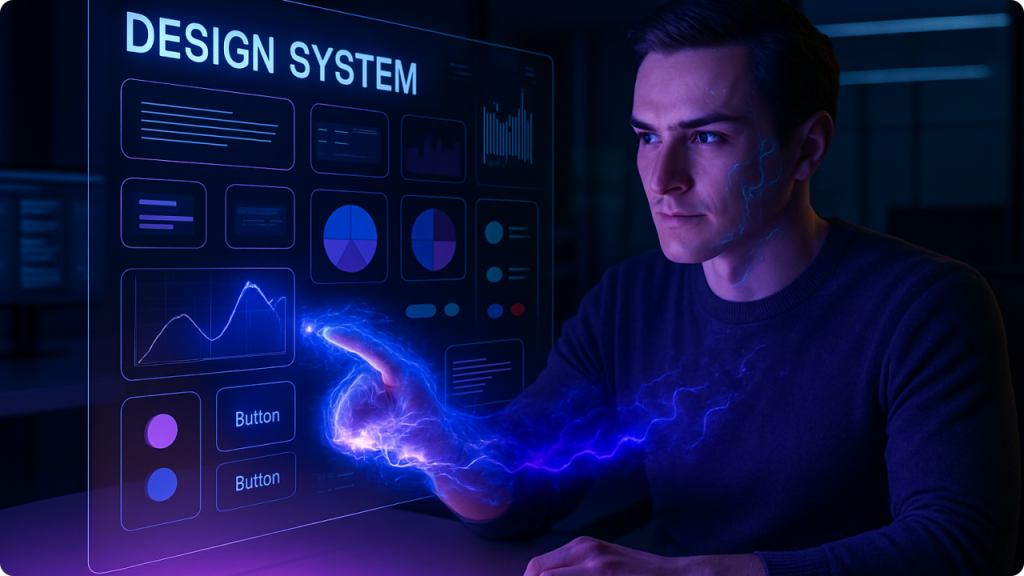
AI is bringing a major shift to the world of design systems. It is no longer just about creating reusable components but about building intelligent frameworks that can adapt, learn, and improve. Below are the key ways Artificial Intelligence is transforming the future of design systems.
1. Automating Repetitive Tasks
AI-powered tools now handle time-consuming and repetitive tasks that once slowed teams down.
- Designers can automate component generation and keep UI elements consistent across platforms.
- AI systems ensure every component adheres to accessibility standards such as the Web Content Accessibility Guidelines.
- This allows designers to focus more on human creativity and less on manual updates or file management.
2. Data-Driven Insights and Analysis
AI’s ability to analyze large datasets and user behavior is reshaping decision-making.
- AI-driven design systems collect and process user feedback in real time to improve usability.
- They offer data-driven insights that reveal how users interact with each design element.
- Teams can make faster and more informed design decisions based on data visualization and performance patterns.
3. Continuous Learning and Improvement
Unlike traditional design systems that remain static, AI-driven systems continuously evolve.
- They learn from usage patterns and adapt based on real-time data.
- AI tools can automatically detect inconsistencies, suggest updates, and refine the component library.
- Continuous improvement becomes part of the design process, ensuring better scalability and efficiency.
4. Enhancing Human Creativity
AI is transforming how human designers work by giving them space to innovate.
- By automating repetitive or routine tasks, AI tools free designers to focus on creative solutions.
- Generative AI can produce early design variations, allowing designers to refine and personalize outcomes.
- Human empathy and intuition still play a central role in creating meaningful user experiences.
5. Preserving Brand Identity Across Platforms
One of AI’s most useful strengths is its ability to maintain cross-platform consistency.
- AI-driven tools analyze brand guidelines, ensuring that every coded component follows the same visual rules.
- They recognize color palettes, typography, and interaction patterns to preserve brand identity.
- Even as new technologies and platforms appear, the design system remains unified and consistent.
6. Integrating AI into Development Environments
AI integration is bridging the gap between design and development.
- Development environments now include AI-driven systems that can generate coded components directly from design files.
- Cross-functional teams can collaborate in real time, improving communication between designers and engineers.
- This integration accelerates workflows while keeping designs accurate and production-ready.
7. Real-Time Feedback and Collaboration
AI systems now offer real-time feedback throughout the design process.
- They can review layouts, detect accessibility issues, and suggest adjustments instantly.
- Designers receive actionable feedback without waiting for long review cycles.
- This creates a faster, more responsive workflow that supports continuous improvement.
8. Balancing Automation with the Human Touch
While AI-driven workflows bring speed and precision, human expertise remains vital.
- Human designers provide the emotional intelligence and creative reasoning that AI cannot replicate.
- The best outcomes come from combining AI performance with human-centered thinking.
- This balance allows teams to solve complex problems while maintaining empathy and authenticity in design.
9. The Path Ahead for AI Design Systems
AI is not replacing design systems but transforming them into smarter, adaptive ecosystems.
- As AI tools evolve, they will become capable of predicting design needs and generating tailored solutions.
- Designers will become orchestrators, guiding AI to align with user needs and brand goals.
- The next generation of design systems will merge AI-driven efficiency with human creativity to deliver experiences that feel truly personal.
Challenges and Risks of AI in Design Systems
AI brings efficiency and innovation to design systems, but it also introduces challenges that teams cannot ignore. As design becomes more data-driven and automated, new risks around creativity, ethics, and quality control begin to appear. Understanding these challenges helps teams prepare for a more balanced approach.
1. Overreliance on AI Tools
When teams depend too heavily on AI-driven systems, they risk losing creative diversity.
- AI models often rely on existing data, which can make outcomes feel repetitive or generic.
- Designs may start to look similar across different brands, leading to a loss of uniqueness.
- Human input remains essential to bring originality, emotion, and innovation into the process.
2. Threat to Human Creativity
While AI can speed up the design process, it may also limit human experimentation.
- Designers might skip the exploration phase and depend on AI-generated layouts or styles.
- This could reduce the natural trial and error that leads to truly creative solutions.
- Encouraging designers to use AI as a collaborator, not a replacement, helps preserve creative thinking.
3. Ethical Concerns and Data Privacy
AI systems learn from large datasets, and this raises serious ethical questions.
- Using unverified or biased data can lead to discrimination or inaccessible design outcomes.
- Data collection without user consent can damage trust and brand reputation.
- Teams must ensure their AI-driven workflows follow ethical standards and privacy laws.
4. Inconsistent Brand Identity
AI-generated content may not always align with a brand’s visual tone or emotional intent.
- Automated systems can misinterpret design elements or apply styles inconsistently.
- Without proper supervision, this may dilute brand identity and reduce user trust.
- Regular human review ensures that the design remains consistent with brand values.
5. Accessibility and Compliance Issues
AI tools do not always guarantee compliance with accessibility standards.
- Automated systems might overlook elements that affect readability or usability.
- Designs that fail to follow Web Content Accessibility Guidelines can exclude users.
- Human testing and validation remain crucial for inclusive design.
6. Lack of Context and Empathy
AI models analyze data but do not understand emotional or cultural nuances.
- Design decisions influenced only by algorithms may miss the emotional connection users seek.
- Human empathy allows teams to understand context, tone, and subtle interactions better.
- Combining AI efficiency with a human-centered approach ensures meaningful user experiences.
7. Bias in AI Models
AI learns from what it is fed, and that can include bias.
- If the training data favors certain patterns or demographics, it can reflect in the designs.
- These biases can lead to exclusionary or culturally insensitive outcomes.
- Regular audits of AI tools help identify and reduce these risks.
8. Quality Control and Accountability
AI can make mistakes that are not easy to detect immediately.
- Automated design generation may introduce inconsistencies in spacing, hierarchy, or layout.
- Without human oversight, these issues can reach production unnoticed.
- Clear review systems, QA processes, and version control are necessary to maintain quality.
9. The Need for Human Oversight
Despite its progress, AI still requires human direction and decision-making.
- Designers must review AI-generated content, test performance, and refine components.
- Human judgment ensures that the design aligns with both user needs and business goals.
- The most successful teams use AI as a support system, not as a substitute for creative expertise.
AI-driven design systems promise incredible speed and accuracy, but they are only as strong as the people guiding them. Keeping humans at the heart of every decision ensures that technology enhances creativity rather than replacing it.
Strategies to Adopt AI in Your Design System Safely
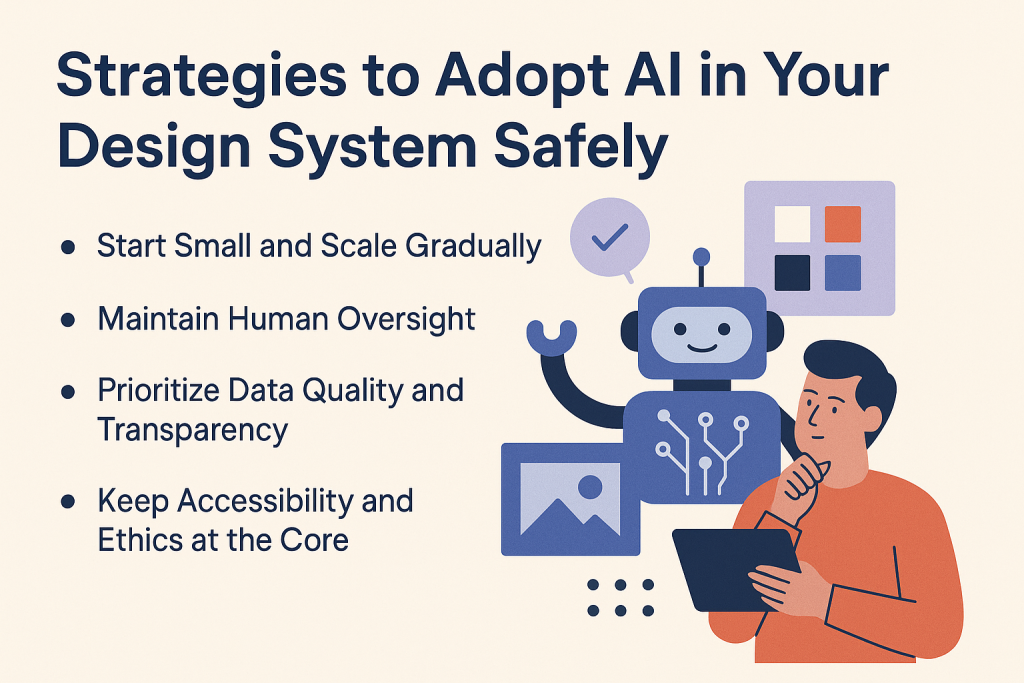
Integrating Artificial Intelligence into design systems can bring powerful results, but only when done thoughtfully. The goal is to blend AI’s efficiency with human insight, ensuring that automation supports creativity instead of replacing it. Here are some practical strategies to help teams adopt AI safely and effectively.
Start Small and Scale Gradually
Begin with specific use cases that solve real problems instead of overhauling your entire workflow at once. Try automating repetitive tasks such as component updates or documentation generation. Once the team is comfortable and sees measurable benefits, you can slowly expand AI integration across design and development.
Maintain Human Oversight
AI can execute fast, but it lacks judgment and emotional understanding. Keep designers involved in reviewing AI-generated components, analyzing results, and refining outcomes. Human oversight ensures that design decisions stay aligned with brand identity, business objectives, and user expectations.
Prioritize Data Quality and Transparency
AI systems are only as good as the data they learn from. Use clean, unbiased, and up-to-date design data to train or inform your tools. Make sure the team understands where data comes from, how it is used, and how it affects the final design output. Transparency builds trust among both designers and stakeholders.
Keep Accessibility and Ethics at the Core
Even as you integrate AI tools, accessibility should remain a top priority. Always verify that AI-generated components meet standards like the Web Content Accessibility Guidelines. Ethical design also means being cautious about data privacy, user consent, and cultural sensitivity in AI-driven outputs.
Encourage Collaboration Across Teams
Successful AI-driven design systems thrive when designers, developers, and product managers work closely together. Encourage open feedback loops and shared experiments between disciplines. When cross-functional teams collaborate, AI becomes a bridge between creativity and execution rather than a barrier.
Continuously Measure and Improve
AI integration is not a one-time project but an evolving process. Track performance metrics such as speed, accuracy, and user satisfaction. Use analytics to evaluate where AI adds real value and where it needs refinement. Continuous improvement ensures your design system stays relevant and effective as AI tools evolve.
Educate and Empower Your Team
The best results come when everyone understands how to use AI effectively. Offer training sessions, share case studies, and create internal guidelines on prompting, reviewing, and improving AI outputs. When your team feels confident using these tools, they are more likely to innovate responsibly.
By following these strategies, design teams can embrace AI without losing their creative edge. The goal is not to let AI take over but to let it assist, enhance, and accelerate the design process while keeping the human touch alive.
The Future of AI-Driven Design Systems
The future of design systems will be defined by the partnership between Artificial Intelligence and human creativity. As AI-driven tools mature, they will not only automate workflows but also help teams make smarter, data-informed design choices. Below are the key directions shaping this next chapter.
Smarter and Adaptive Design Systems
AI-driven design systems of the future will adapt to changing user needs in real time. They will analyze user behavior, gather feedback, and update UI components automatically. This adaptability will make design systems more responsive and capable of delivering personalized experiences without manual intervention.
AI as a Creative Partner
AI will move from being a task assistant to becoming a true creative collaborator. Designers will use generative AI to explore diverse design directions faster, while still guiding the system with their vision and expertise. This collaboration will produce innovative results that combine machine precision with human imagination.
Stronger Focus on Human-Centered Design
Even in an AI-driven world, the human element will remain at the heart of good design. Teams will continue to apply empathy, ethics, and intuition to ensure that AI-generated experiences feel authentic. AI can provide insights, but it is human understanding that makes those insights meaningful.
Integration Across Tools and Platforms
Future AI systems will be more tightly integrated into design tools and development environments. Designers will move seamlessly between Figma, code editors, and analytics dashboards powered by AI. This cross-platform consistency will eliminate silos and improve collaboration among teams.
Data-Driven Decision Making
AI’s ability to analyze large datasets will become a core advantage for design teams. By offering real-time feedback and data visualization, AI will help teams make informed design decisions faster. This will not only improve user satisfaction but also strengthen alignment between design, development, and business goals.
Continuous Learning and Improvement
AI-driven design systems will continuously improve through pattern recognition and user feedback. Over time, they will learn what works best for different audiences, adjusting colors, layouts, and components accordingly. The result will be living systems that evolve alongside their users and brands.
Ethical and Responsible AI Design
As AI takes on more responsibility, ethical design will become even more important. Teams will need to ensure fairness, inclusivity, and transparency in every AI decision. Clear accountability frameworks will help keep AI systems aligned with human values and societal expectations.
The Next Generation of Design Collaboration
In the future, design systems will unite cross-functional teams through shared AI-driven workflows. Developers, designers, and product strategists will all work with intelligent systems that understand context and intent. The combined power of human creativity and AI performance will lead to smarter, more consistent, and scalable design outcomes.
The future of AI-driven design systems is not about replacing human expertise but amplifying it. When AI handles complex data and repetitive work, it gives designers the freedom to imagine, innovate, and connect deeply with users. The most successful teams will be those that embrace AI while keeping human creativity at the core of every decision.
Conclusion
Artificial Intelligence is transforming design systems from static libraries into intelligent, ever-evolving ecosystems. It is helping teams automate repetitive work, analyze user data, and build more consistent and inclusive designs. But the real power of AI lies in how it complements human creativity rather than replacing it.
As AI tools become more advanced, the role of designers will evolve from crafting individual components to orchestrating entire intelligent workflows. The future will belong to those who know how to balance automation with empathy, precision with imagination, and data with intuition.
Design systems will continue to be the foundation of scalable and consistent design, but now they will think, adapt, and learn alongside the people who build them. The challenge and the opportunity lie in using AI to enhance what makes design truly human – curiosity, emotion, and the desire to make things better.